
- Age: 8+ } ?>
- Time: 60 } ?>
- Set-up: 10 min, Activity: 40 min, Clean-up: 10 min } ?>
- Materials: $15 } ?>
In this underwater mission, you'll explore how changing ocean conditions could affect materials like coral.
} ?> Download PDF } ?>-
what you need
WHAT YOU NEED
Materials:
- 1 red cabbage
- Bottled alkaline water (1 cup)
- White vinegar (1 cup)
- 1 lemon or 1/2 cup lemon juice
- Tap water (1 cup)
- Antacid tablets (e.g., Tums)
- Straws
- Permanent markers
- 12-16 clear plastic cups
- Additional household liquids (optional)
- Crushed eggshells (optional)
Equipment
- Blender
- Spoons
- Liquid measuring cup
-
What To Do
WHAT TO DO
Set Up:
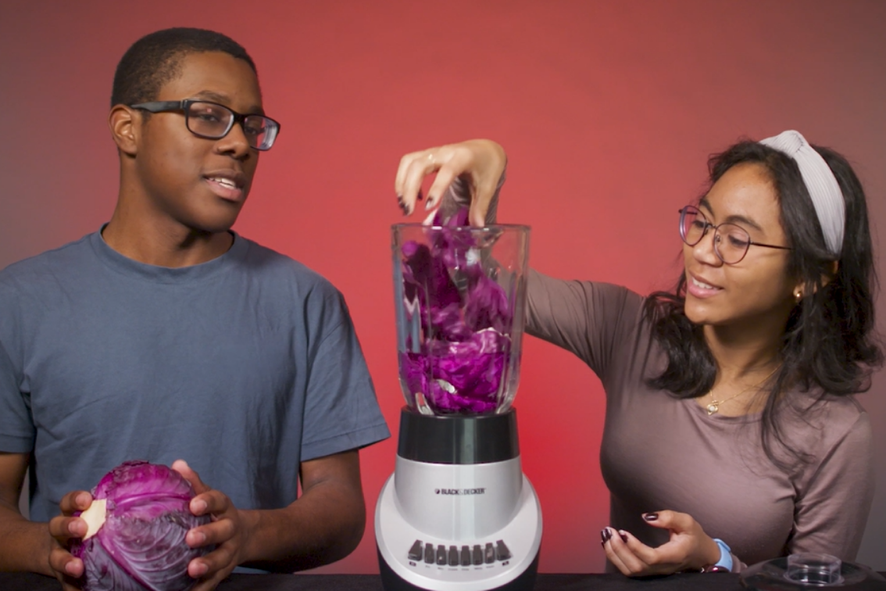
- With help from a grownup, prepare your acidity indicator solution.
- Cut a small red cabbage into pieces.
- Place the cabbage pieces in a blender and add enough water to cover them.
- Blend the cabbage and water until smooth.
- Make lemon water as one of your test liquids. Mix either 1/2 cup of water with 1/2 cup of lemon juice, or squeeze the juice from one lemon into 1 cup of water.
Part 1: Measuring acidity
- You will be measuring the acidity of four different water-based liquids. To keep them organized, label four clear cups: Alkaline Water, Tap Water, Lemon Water, and Vinegar. Pour 1 cup of the corresponding liquid into each of your labeled cups.
- Grab four new empty cups and again label them with the names of the liquids. Use a straw to add the red cabbage indicator solution, just enough to fully cover the bottom of each new cup. To do this, dip a straw down into the cabbage liquid (avoid any solid stuff that may have settled at the bottom), cover the top of the straw with your finger, lift the straw out and position it over the cup, and release your finger to let the liquid fall out.
- Add a ½ cup of each liquid (that’s half the amount in your original cups!) to its correspondingly labeled cup containing the red cabbage indicator solution. Stir or gently swirl to mix.
- Observe how the color of each liquid changes compared to its original cup. If a change isn’t obvious, add more red cabbage indicator. Avoid mixing liquids between containers. Using the color chart below, decide whether each liquid is acidic, neutral, or non-acidic:
- Acidic solutions will turn the indicator red or pink.
- Neutral solutions will keep the indicator purple.
- Non-acidic solutions will turn the indicator blue or green.
- Record your observations on the Data Sheet by circling the best color match that you observe for each. Which liquid is the most acidic?
- Optional: Repeat the activity with other household liquids to test their acidity. Check with a grownup to make sure your materials are safe to work with!
Part 2: Reactions with calcium carbonate
- Label 4 new clear cups again: Alkaline Water, Tap Water, Lemon Water, and Vinegar.
- Antacid tablets contain calcium carbonate, the same material that forms the structure of coral reefs. We will use the tablets as a coral substitute to test how acidic liquid affects coral. Place one tablet into each empty cup.
- Take your original cup of Lemon Water (not the one with the red cabbage indicator), and slowly pour just enough to barely cover the tablet. Watch closely and record your observations on the Data Sheet. Do you see bubbles or not? Circle your result.
- Repeat these steps for the other three liquids, again using the original cup of each. Be sure to record your observations each time.
- Look closely at your results on the Data Sheet and compare the four liquids.
How does the acidity of a liquid affect its reaction with calcium carbonate? Do you see a clear pattern that helps you draw a conclusion? If not, what could you do to gather more evidence?
Go further: Modeling coral with eggshells
Eggshells also contain calcium carbonate. Their structure is even more similar to coral than antacid tablets, so the experiment is more realistic but you’ll need more time, patience, and observation skills to see the effect.
- Place a small amount of crushed eggshells into four new cups. Label each cup with the same four liquids.
- Use the straw to add each liquid to its corresponding cup of crushed eggshells, again adding just enough to cover the shells.
- Place the experimental cups in a location where they can remain for several days. To prevent the liquid from evaporating during the experiment, cover the top of each cup with plastic wrap.
- Check the cups at least once or twice a day. (It could take several days to see changes.) Observe carefully and record your observations each time you check the eggshells. Taking pictures may help to remember what each sample looked like at the start. What do you notice over time?
- Compare the speed and results of this reaction to the activity using antacid tablets. What conclusions can you draw? Are your results consistent with your first experiment? What else do you want to know?
Clean-up:
Pour any leftover liquids down the drain and rinse the cups. Recycle the cups if possible. Clean the blender and any other tools you use. Dispose of the tablets (and eggshells) in the trash. Be sure to wipe down and clean all surfaces. Be sure to wash your hands.
-
What's Happening?
WHAT'S HAPPENING
You used red cabbage as a natural indicator for measuring acidity. This helped you determine the level of acidity of each of your water-based liquids.
When you poured these liquids over antacid tablets, you were able to observe a chemical reaction. Acidic liquids react with the tablet to break down calcium carbonate and produce carbon dioxide gas, forming bubbles. Neutral or non-acidic liquids do not react with calcium carbonate, so no bubbles form
Since coral skeletons are also formed from calcium carbonate, testing the effect of different levels of acidity on antacid tablets helps us understand what may be happening to coral reefs as ocean water becomes more acidic.
-
So What?
Image credit: Adobe Stock
SO WHAT?Coral reefs provide important benefits and play a vital role in the ocean’s ecosystem. They provide habitats for fish and other marine life, protect shorelines from storm damage, and support humans by providing food, recreation, and even potential medicines. However, human activities that add more carbon dioxide to the atmosphere may be putting coral reefs at risk. When ocean water traps this carbon dioxide, the water becomes more acidic. As you saw in your experiment, more acidic liquids break down calcium carbonate structures like coral skeletons, making it harder for them to survive. The speed at which this breakdown happens in the ocean is very slow compared to your experiment, but over time, sea water acidification can lead to the destruction of living corals.
To help protect corals, each of us can reduce activities that increase carbon dioxide—like driving less—while we work together to move away from burning fossil fuels for electricity. By keeping ocean waters from becoming too acidic, we can safeguard the health of coral reefs and the benefits they provide for the environment and our communities.
- Scientists In Action
-
For Teachers
For Teachers
Below are suggested alignments with the Next Generation Science Standards. For the full list, please scroll down and download the PDF.
Performance Expectations:
- 3-LS3-2: Use evidence to support the explanation that traits can be influenced by the environment.
- 4-LS1-1: Construct an argument that plants and animals have internal and external structures that function to support survival, growth, behavior, and reproduction.
- 4-ESS2-1: Make observations and/or measurements to provide evidence of the effects of weathering or the rate of erosion by water, ice, wind, or vegetation.
- 4-ESS3-2: Generate and compare multiple solutions to reduce the impacts of natural Earth processes on humans.
- 3-5-ETS1-3: Plan and carry out fair tests in which variables are controlled and failure points are considered to identify aspects of a model or prototype that can be improved.
- 5-PS1-3: Make observations and measurements to identify materials based on their properties.
- 5-PS1-4: Conduct an investigation to determine whether the mixing of two or more substances results in new substances.
- MS-PS1-2: Analyze and interpret data on the properties of substances before and after the substances interact to determine if a chemical reaction has occurred.
- MS-LS2-1: Analyze and interpret data to provide evidence for the effects of resource availability on organisms and populations of organisms in an ecosystem.
- MS-LS2-4: Construct an argument supported by empirical evidence that changes to physical or biological components of an ecosystem affect populations.
- MS-ESS3-2: Analyze and interpret data on natural hazards to forecast future catastrophic events and inform the development of technologies to mitigate their effects.
- MS-ESS3-3:Apply scientific principles to design a method for monitoring and minimizing a human impact on this environment.
- MS-ESS3-5: As questions to clarify evidence of the factors that have caused the rise in global temperatures over the past century.
Disciplinary Core Ideas:
LS3.B: Inheritance of Traits
Grade 3
- The environment also effects the traits that an organism develops.
LS1.A: Structure and Function
Grade 4
- Plants and animals have both internal and external structures that serve various, functions in growth, survival, behavior, and reproduction
ESS2.A: Earth Materials Systems
Grade 4
- Rainfall helps to shape the land and affects the types of living things found in a region. Water, ice, wind, living organisms, and gravity break rock, soils, and sediments into smaller particles and move them around.
ESS2.E: Biogeology
Grade 4
- Living things affect the physical characteristics of their regions.
ESS3.B: Natural Hazards
Grade 4
- A variety of hazards result from natural processes. Humans cannot eliminate the hazards but can take steps to reduce their impacts.
PS1.A: Structure and Properties of Matter
Grade 5
- Measurements of a variety of properties can be used to identify materials.
PS1.B: Chemical Reactions
Grade 5
- When two or more different substances are mixed, a new substance with different properties may be formed.
Middle School
- Substances react chemically in characteristic ways. In a chemical process, the atoms that make up the original substances are regrouped into different molecules, and these new substances have different properties from those of the reactants.
ETS1.C: Optimizing the Design Solution
Grade 3-5
- Different solutions need to be tested in order to determine which of them best solves the problem, given the criteria and the constraints.
PS1.A: Structure and Properties of Matter
Middle School
- Each pure substance has characteristic physical and chemical properties that can be used to identify it.
LS2.A: Interdependent Relationships in Ecosystems
Middle School
- Organisms, and populations of organisms, are dependent on their environmental interactions both with other living things and with nonliving factors.
- In any ecosystem, organisms and populations with similar requirements for food, water, oxygen, or other resources may compete with each other for limited resources, access to which consequently constrains their growth and reproductions.
- Growth of organisms and population increases are limited by access to resources.
LS3.C: Ecosystem Dynamics, Functioning, and Resilience
Middle School
- Ecosystems are dynamic in nature; their characteristics can vary over time. Disruptions to any physical or biological component of an ecosystem can lead to shifts in all populations.
ESS3.B: Natural Hazards
Middle School
- Mapping the history of natural hazards in a region, combined with an understanding of related geological forces can help forecast the locations and likelihoods of future events.
ESS3.C: Human Impacts on Earth Systems
Middle School
- Human activities have significantly altered the biosphere, sometimes damaging or destroying natural habitats and causing the extinction of other species. But changes to Earth’s environments can have different impacts (negative and positive) for different living things.
ESS3.D: Global Climate Change
Middle School
- Human activities, such as the release of greenhouse gases from burning fossil fuels, are major factors in the current rise in Earth’s mean surface temperature.
Please click on the PDF below for a more detailed description of how this activity ties to NGSS
Download PDF } ?>