Bouncy Behaviors

image-description
Bouncy Behaviors
  • Age: 8+
  • Time: 60
  • Set-up: 10 min, Activity: 35 min, Clean-up: 15 min
  • Materials: $15

In this messy mission, you’ll mix up three different recipes to make bouncy balls and test which ingredients make them bounce the best.

Download PDF
  • what you need
    WHAT YOU NEED

    Materials:

    • Popsicle Sticks
    • Cornstarch
    • Elmer's all-purpose glue or Elmer's glitter glue (if you want color)
    • Borax (work with a grownup!)
    • Warm water
    • Paper
    • Marker
    • Tape
    • Cereal box (or other tall box for the backdrop)
    • Disposable gloves (optional)
    • Newspaper/trash bags

    Equipment

    • Small cups (4 or 6 ounces)
    • A larger cup or bowl (for the borax solution)
    • Measuring cup
    • Measuring spoons
    • Ruler
    • Smartphone or other video recording device
    • A friend!
  • What To Do
    WHAT TO DO

    In this messy mission, you will find the best recipe for making a high-bouncing bouncy ball by experimenting with different ingredient combinations, testing the property of bounciness, and recording your results like a true materials scientist!


    Initial set up:


    1. Prepare the borax solution

      • Mix 1/2 cup of warm water with 1 tablespoon of borax. (It may look cloudy.)

      • Set the borax solution aside.

    2. Create a backdrop to help measure how high the balls bounce.

      • Mark a piece of paper with horizontal lines at 1/2-inch increments.

      • Tape it to the side of a tall box for easy viewing.

      • Set up the backdrop on a hard surface

    3. Lay out some newspaper or a trash bag to protect your work surface.

    Part 1: Create the bouncy balls

    1. You'll try three different recipes to make three different balls.

    2. Label three cups A, B, and C. For each, follow the recipe on the Data Sheet:

      • Cup A: Mix 1 tablespoon of cornstarch and 1 tablespoon of glue, then add 1/2 teaspoon of borax solution.

      • Cup B: No cornstarch in this one. Mix 1 tablespoon of glue and 1/2 teaspoon of borax solution.

      • Cup C: Mix 1/2 tablespoon of cornstarch and 1 tablespoon of glue, then add 1/2 teaspoon of borax solution.

    3. Let each mixture sit for ~15 seconds, then stir with a popsicle stick until it clumps. Roll the clump into a ball with your hands, applying pressure. If it's too sticky, add a few drops of borax solution to smooth it out. Bouncy balls can be tricky to make, so don't worry if it takes a few tries!

    4. Play with all three balls, but be sure to keep track of which is A, B, and C. Which ball would you recommend to your friends? Why?

    Part 2: Grab a friend and measure the bounce

    1. One person will drop the ball for each test. Make each ball as round as possible so they bounce straight up. Hold each ball at the top of the paper backdrop—record this height on your data sheet!—then let it drop from your fingers. Be sure to drop the balls from the same height each time. Why do you think this is important?

    2. The second person will record a video of each test with your phone’s camera. Hold each ball at the top of the paper backdrop and let it bounce off a hard surface to measure the height of its first bounce. View the video on your phone’s camera. Replay the video, pause at the first bounce, and record the height measurement on your Data Sheet.

    3. Think about your results. Which recipe made the highest-bouncing ball: A, B, or C? Take a moment to think about your results: Would you recommend either of the other balls for a different reason besides bounciness?

    Go further: Beyond the bounce

    1. Different tests: Scientists design different ways of testing a property. Try testing bounciness by comparing a variety of different starting heights. Or, count how many times each ball bounces before coming to rest. Test the durability of a ball by dropping it multiple times and seeing whether that first bounce height stays the same.

    2. Different methods: Materials scientists also try making materials in different ways, or with different ingredients, to see how those changes affect a property. Try making different balls by changing the type of glue, adding other ingredients, or using different amounts. You could also try freezing (or heating) the balls before testing them.

    3. Different properties: Instead of bounciness, try designing for a totally different property, such as hardness or stretchiness. Based on your observations, what mixtures and methods would you try?

    Clean-up:


    To save your bouncy balls, place them in a sealed plastic bag so they don’t dry out. They may flatten out, but can be reshaped by rolling.


    Gather all materials and discard any leftover borax solution, glue, or cornstarch in the trash. Dispose of the newspaper or trash bag. Wipe down surfaces with a damp cloth to remove any residue. Wash your hands well after handling the materials.

  • What's Happening?
    WHAT'S HAPPENING

    Let’s look at the ingredients in your bouncy balls. You start with glue, which is made of long chains of molecules that slide past each other—this is what makes glue stretchy and sticky. The borax then connects the glue chains together. Cornstarch soaks up excess water to add structure, helping the material hold its shape. But even though your bouncy balls have similar ingredients, the different amounts in each mixture cause differences in how the balls feel and bounce. Scientists experiment in similar ways when designing materials by adjusting ingredients and amounts for specific results.

  • So What?
    image-description
    SO WHAT?

    Materials scientists don’t just rely on stuff we find in nature—they design new materials with new properties that help us develop new technologies. The materials design process starts with an idea about a property (like bounciness, in this experiment) that you want to improve. Then, scientists create (or synthesize) the material and run different tests to check (or characterize) its qualities and behaviors. Often the results aren’t what they expected, and they have to try again. Just like you did, they test (or iterate) with different variations, changing ingredients and amounts or using special tools and measurement equipment, until they achieve the property they want. Congrats, you’re a materials designer too!

  • Scientists In Action
    image-description
    Scientist in Action

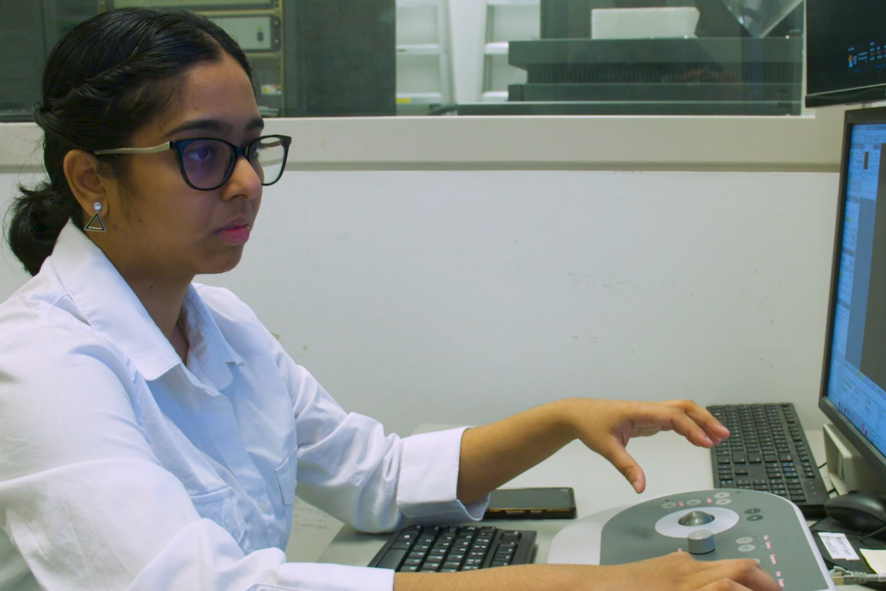
    Materials scientists Gaurav Ranjan Dey, Katherine Thompson, and Sai Venkata Gayathri Ayyagari, explore how materials are made, what they’re made of, and how they behave. By changing the ingredients and how they’re combined, they can create brand-new materials!

  • For Teachers
    For Teachers Below are suggested alignments with the Next Generation Science Standards. For the full list, please scroll down and download the PDF.

    Performance Expectations


    • 3-PS2-2: Make observations and/or measurements of an object’s motion to provide evidence that a pattern can be used to predict future motion.
    • 4-PS3-3: Ask questions and predict outcomes about the changes in energy that occur when objects collide.
    • 5-PS1-3: Make observations and measurements to identify materials based on their properties.
    • 5-PS1-4: Conduct an investigation to determine whether the mixing of two of more substances results in new substances.
    • 3-5-ETS-1:Define a simple design problem reflecting a need or a want that includes specified criteria for success and constraints on materials, time, or cost.
    • 3-5-ETS-3: Plan and carry out fair tests in which variables are controlled and failure points are considered to identify aspects of a model or prototype that can be improved.
    • MS-PS3-2: Develop a model to describe that when the arrangement of objects interacting at a distance changes, different amounts of potential energy are stored in the system.
    • MS-ETS1-1: Define the criteria and constraints of a design problem with sufficient precision to ensure a successful solution, taking into account relevant scientific principles and potential impacts on people and the natural environment that may limit possible solutions.
    • MS-ETS1-2: Evaluate competing design solutions using a systematic process to determine how well they meet the criteria and constraints of the problem.
    • MS-ETS1-4: Develop a model to generate data for iterative testing and modification of a proposed object, tool, or process such that an optimal design can be achieved.

    Disciplinary Core Ideas


    PS2.A: Forces and Motion

    Grade 3

    • The patterns of an object’s motion in various situations can be observed and measured when the past motion exhibits a regular pattern, future motion can be predicted from it.

    Middle School

    • A system of objects may also contain stored (potential) energy, depending on their relative positions.

    PS3.A: Definition of Energy

    Grade 4

    • Energy can be moved from place to place by moving objects or through sound, light, or electric currents.

    PS3.B Conservation of Energy and Energy Transfer

    Grade 4

    • Energy is present whenever there are moving objects, sound, light, or heat. When objects collide, energy can be transferred from one object to another, thereby changing their motion.

    PS3.C: Relationship Between Energy and Forces

    Grade 4

    • When objects collide, the contact forces transfer to the conversion of stored energy into a desired form for practical use.

    Middle School

    • When two objects interact, each one exerts a force on the other that can cause energy to be transferred to or from the object.

    PS1.A: Structure and Properties of Matter

    Grade 5

    • Measurements of a variety of properties can be used to identify materials.

    PS1.B: Chemical Reactions

    Grade 5

    • When two or more different substances are mixed, a new substance with different properties may be formed.

    ETS1.A: Defining and Delimiting Engineering Problems

    Grade 3-5

    • Possible solutions to a problem are limited by available materials and resources (constraints).

    Middle School

    • The more precisely a design task’s criteria and constraints can be defined, the more likely it is that the designed solution will be successful.

    ETS1.B: Developing Possible Solutions

    Grade 3-5

    • Tests are often designed to identify failure points or difficulties, which suggest the elements of the design that need to be improved.
    • Research on a problem should be carried out before beginning to design a solution.

    Middle School

    • There are systematic processes for evaluating solutions with respect to how well they meet the criteria and constraints of a problem.
    • Models of all kinds are important for testing solutions.

    ETS1.C: Optimizing the Design Solution

    Grade 3-5

    • Different solutions need to be tested in order to determine which of them best solves the problem, given the criteria and the constraints.

    Middle School

    • The iterative process of testing the most promising solutions and modifying what is proposed on the basis of the test results leads to greater refinement and ultimately to an optimal solution.

    Please click on the PDF below for a more detailed description of how this activity ties to NGSS

    Download PDF